The vision of the Garr Barry lab is to advance maternal health and reduce disparate outcomes through precision nutrition and the integration of wearable technology and remote monitoring into obstetrics. A central priority of the lab is to unravel biological factors that drive racial disparities in pregnancy outcomes. As such, the lab focuses on two of the most prominent drivers of racial disparities in pregnancy outcomes: fetal growth restriction and hypertensive disorders of pregnancy.
Our lab’s mission is to 1) conduct well-executed, objective, and impactful research on the effects of nutrient availability and metabolic inflexibility on pregnancy outcomes and postpartum cardiometabolic recovery; 2) perform culturally competent and respectful investigations of racial differences in cardiovascular and metabolic adaptation to pregnancy; and 3) use precision nutrition approaches to improve racial disparities in pregnancy outcomes and cardiometabolic recovery among patients with adverse pregnancy outcomes.
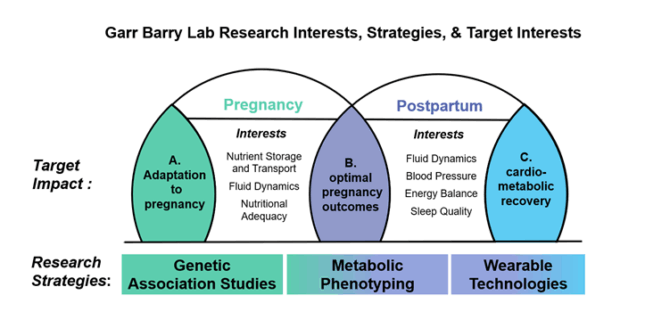
The Garr Barry Lab’s Current Projects:
- Precision Nutrition Approaches to Fetal Growth Restriction Among Black Women.
Uses applied genomics and metabolic phenotyping to examine maternal nutrient availability, upstream of placental function, as a novel antecedent for fetal growth restriction in the pregnancies of Black women. - An Evaluation of Nutritional Adequacy and Diet Quality Among Pregnant Women and It’s Association with Adverse Pregnancy Outcomes.
Uses probabilistic modeling of dietary intake to characterize the adequacy of micronutrient, macronutrient, and food-group intake across varying age, body size, and risk profiles with a goal to develop targeted nutritional recommendations for pregnant patients. - A Wearables Approach to Chronic Hypertension and Preeclampsia.
Uses wearable devices with bioelectrical impedance sensors to investigate the feasibility and acceptability of continuous fluid volume monitoring in pregnant patients with hypertension for early detection of preeclampsia onset.